


Radiation Effects on Semiconductors
Radiation acting on electronic devices is typically grouped into three categories:
1. SEE (Single Event Effects)
SEE arise when radiation (e.g., protons, neutrons, heavy ions, photons) ionizes the semiconductor and the generated electron–hole pairs are collected at a sensitive node, perturbing circuit operation. If the collected charge exceeds the node’s critical charge, an error occurs. Most SEEs are non-destructive and transient—a reset or power cycle restores normal operation. In practice, SEE susceptibility is often evaluated with heavy-ion testing.
SEE types
- SEU (Single Event Upset): data bit flip
- SET (Single Event Transient): transient voltage pulse
- SEL (Single Event Latch-up): PNPN conduction path in CMOS
- SEB (Single Event Burnout) / SEGR (Single Event Gate Rupture): destructive events in high-power devices
- SEFI (Single Event Functional Interrupt): system-level interruption
2. TID (Total Ionizing Dose)
Ionizing radiation produces charge that accumulates in oxides and at interfaces, gradually shifting device parameters. In CMOS, trapped charge in the gate oxide and interface states can alter threshold voltage and leakage, among other effects. TID is commonly evaluated with gamma irradiation (e.g., Co-60).
Key impacts
- Shift of MOSFET threshold voltage (Vth)
- Reverse thresholding and increased drain leakage
- Changes in functional characteristics
3. DD (Displacement Damage)
Displacement Damage occurs in the device bulk: incident particles knock atoms out of the lattice, creating defects. Unlike surface/interface-dominated TID, DD affects bulk electrical/optical/thermal properties, degrading device performance or causing failure. DD is commonly evaluated with neutron irradiation.
Key impacts
- Reduced carrier lifetime and mobility
- Increased reverse saturation current in PN junctions
- Overall performance degradation
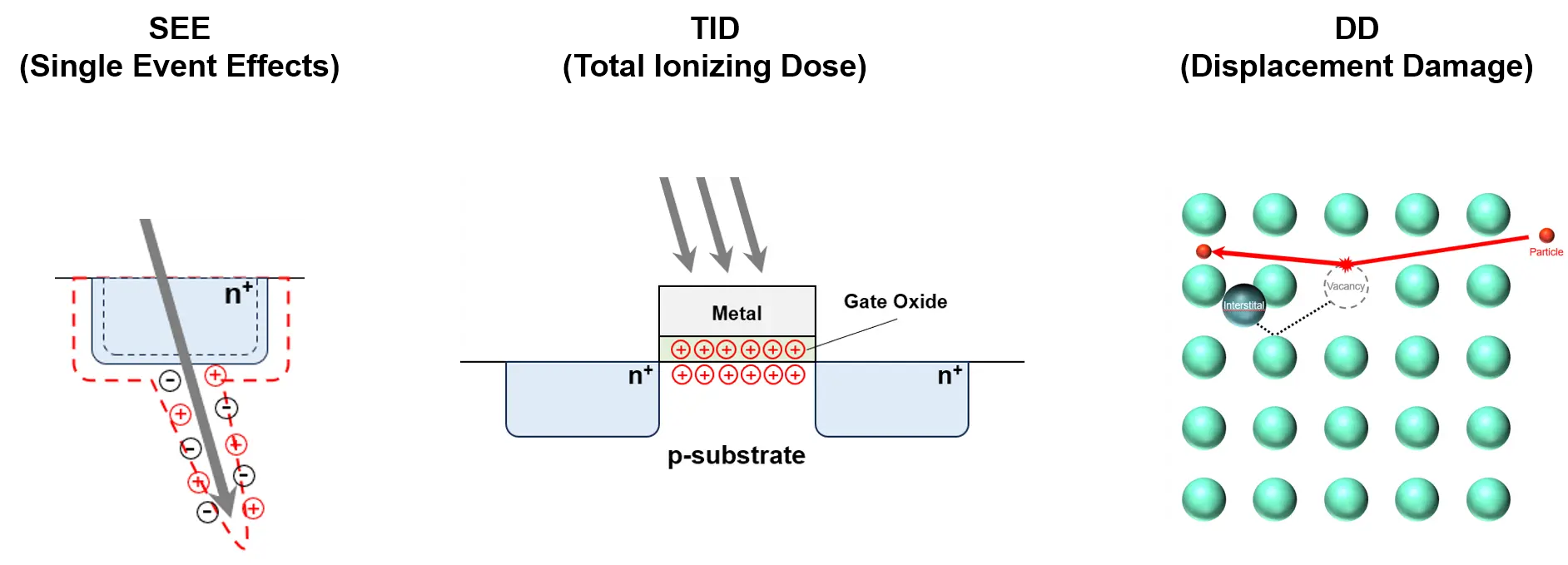
Radiation effects on semiconductors
Types of Radiation
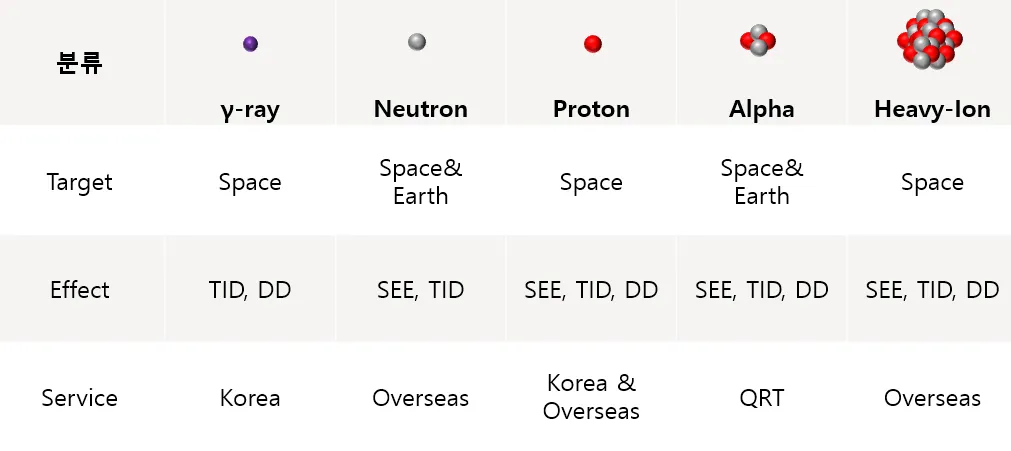
Among many radiation sources, the following are most relevant to semiconductor reliability:
Gamma rays
On Earth, ambient gamma effects on electronics are typically negligible; in space they contribute significantly to TID. High-energy fields can generate secondary electrons that may contribute to bulk damage, but TID dominates in most device testing environments.
Neutrons
Neutrons are relevant to both ground (e.g., aviation altitudes, high-availability servers) and space environments. At ground level, atmospheric neutrons can induce SEE; in space, neutrons are also an important driver of DD.
Protons
Protons are a major component of the space environment (solar particles, Van Allen belts). They can cause SEE, TID, and DD, making proton testing a core element of space qualification. Ground-level proton effects are usually negligible.
Alpha particles
Trace radioisotopes in packaging materials (e.g., U/Th chains, Pb-210/Po-210) or neutron-capture reactions such as 10B(n,α)7Li can emit alpha particles that induce SEE. Because alpha sources (e.g., Am-241) are easy to handle, alpha-induced SEE can be screened conveniently in the lab.
Heavy ions
High-LET ions in space primarily drive SEE and are widely used for SEE evaluation. Representative standards include JEDEC JESD57 and ESCC 25100.
Each radiation type interacts with devices differently. Click the items above for mechanisms and test methods.
Related Aticles
- Radiation Hardness Test
- What is SEE (Single Event Effect)?
- What is LET (Linear Energy Transfer)?
- What is the TID (Total Ionizing Dose) Effect?
- What is DD (Displacement Damage)?
- Accidents Caused by Soft Errors
- What is a Heavy-Ion Beam?
::contentReference[oaicite:0]{index=0}